



The California Pending Budget Crisis
California’s fiscal picture in 2026 is mixed. The state is not in an immediate budget crisis, but it is also not free from long-term financial pressure.
California's Pending Budget Crisis
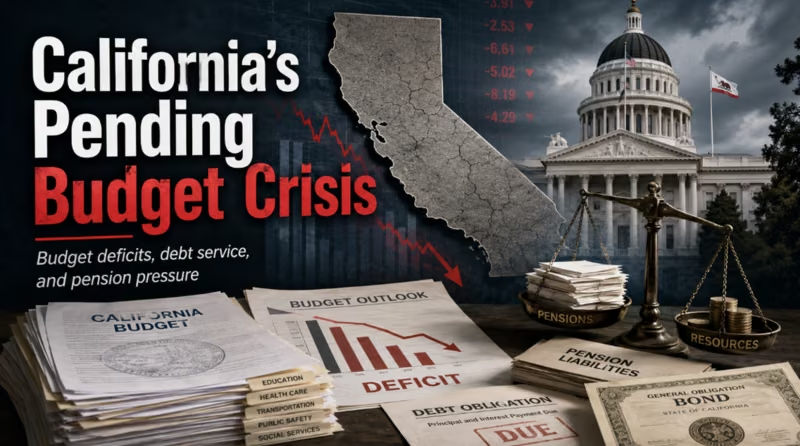
California is not broke today, but the warning signs are easy to see. The state has a massive budget, large reserves, a powerful economy, and strong credit ratings. At the same time, California also has recurring budget pressure, rising debt service, major pension obligations, and a tax system that depends heavily on high-income earners and capital gains.
The result is a state budget that can appear balanced in one year while still carrying serious long-term risk into the next several years.
The Current Budget Picture
California's 2026-27 budget was signed as a balanced budget. The state reported no deficit for the current budget year and preserved roughly $30 billion in reserves, or more than $35 billion when additional holding accounts are included.
That sounds encouraging, and in the short term it is. Reserves give the state flexibility. They help California avoid sudden cuts when revenue falls or unexpected costs rise. But reserves do not automatically solve the deeper problem: ongoing spending continues to place pressure on ongoing revenue.
This is the difference between a budget that is balanced on paper and a budget that is structurally healthy. California can balance a budget year with reserves, delayed spending, temporary revenue, borrowing tools, fund shifts, and accounting adjustments. A structurally healthy budget is different. It means recurring tax revenue is enough to pay recurring expenses without relying on short-term fixes.
The Structural Deficit Problem
The main concern is California's structural deficit. Even when the state closes one budget gap, new gaps are projected in future years. Legislative and budget analysts have warned that California faces multi-billion-dollar operating deficits in the out-years if spending grows faster than revenue.
This matters because a structural deficit does not usually explode all at once. It builds slowly. A few billion dollars of pressure becomes ten billion. Ten billion becomes twenty billion. Then, when a recession or stock market downturn hits, the state suddenly has to make painful choices.
California's revenue system makes this problem worse because the state depends heavily on personal income taxes from high earners. When the stock market is strong, capital gains and income tax collections can surge. When the market weakens, those same revenues can fall quickly. That makes California's budget more volatile than many other states.
Debt Service Is Becoming a Bigger Issue
California also carries significant bond debt. State bond debt is not the same thing as household credit card debt, and not all public debt is bad. Bonds are often used to pay for long-term infrastructure, schools, water systems, transportation, housing programs, and other public investments.
But debt still has to be serviced. Every year, the state must make principal and interest payments. As more bonds are issued, debt service consumes more of the General Fund. That means fewer dollars are available for current services, new programs, tax relief, or emergency needs.
The State Treasurer's debt reporting has shown tens of billions of dollars in outstanding General Fund-supported bond obligations, plus additional authorized but unissued debt. California is also expected to continue issuing new debt in the coming years.
The concern is not that California cannot pay its debt today. The concern is that debt service can quietly become a larger fixed cost. Fixed costs reduce flexibility. When a future downturn comes, the state cannot simply skip bond payments. That means other areas of the budget may take the hit.
Pension Obligations Are a Long-Term Pressure
Pensions are another major issue. California's large public pension systems, including CalPERS and CalSTRS, are better funded than they were during some past periods, but they are still not fully funded.
A pension system that is roughly 79% funded still has a meaningful gap between promised benefits and the assets currently set aside to pay for them. Investment gains can improve the funded ratio, but investment losses can quickly reverse that progress.
This creates risk for taxpayers, public agencies, school districts, and future state budgets. If pension systems underperform, required contributions may rise. Those higher contributions can crowd out other spending at both the state and local levels.
This is why pensions should be viewed as part of California's larger fiscal picture. The issue is not only the annual state budget. The issue is the combined weight of operating expenses, bond debt, pension obligations, health care costs, education funding formulas, and future promises.
Why the Crisis May Be Pending, Not Immediate
California's pending budget crisis is not necessarily a sudden collapse. It is more likely to be a slow squeeze.
The state may continue passing balanced budgets for a few years. It may use reserves, temporary taxes, spending delays, fund transfers, and selective cuts. But each year of structural imbalance makes the future harder. The longer California waits to fix the underlying mismatch between spending and revenue, the fewer easy options remain.
A future recession, stock market decline, technology sector slowdown, or federal funding reduction could expose the weakness quickly. If revenue drops while debt service, pension contributions, Medi-Cal, education, and other fixed obligations keep rising, California could face a much more difficult budget environment.
The Main Issues California Needs to Resolve
California's fiscal challenges are not mysterious. The state needs to address several obvious pressure points:
- Ongoing spending versus ongoing revenue: California needs a clearer plan to keep recurring programs aligned with recurring tax collections.
- Revenue volatility: The state needs to account for the fact that high-income tax revenue and capital gains can rise and fall dramatically.
- Debt service: California needs to be careful about how much future General Fund revenue is committed to bond repayment.
- Pension obligations: Public pension systems need continued attention so unfunded liabilities do not place more pressure on future budgets.
- Reserve discipline: Reserves should be protected for true downturns, not used as a routine tool to cover normal operating gaps.
- Long-term transparency: Budget discussions should focus not only on the next fiscal year, but also on the three-to-five-year outlook.
The Bottom Line
California remains one of the largest and most economically important states in the country. It has a huge tax base, a large economy, and the ability to raise significant revenue. But that does not make the state immune from fiscal problems.
The warning signs are already visible. Budget deficits keep reappearing. Debt service is a growing fixed cost. Pension systems remain underfunded. Health care and education obligations continue to rise. Revenue remains highly dependent on high-income taxpayers and capital gains.
California's budget crisis may not be here in full force today, but it is pending unless the state makes serious long-term changes. A balanced budget for one year is helpful. A sustainable budget for the next decade is what California really needs.